

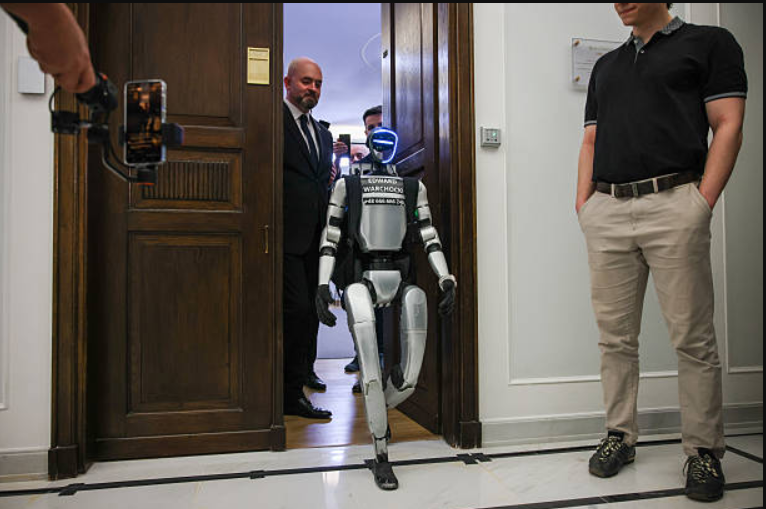
For years, China has dominated industries such as manufacturing, electronics, solar panels, and electric vehicles. Now, the country is preparing for what could become its next technological revolution: humanoid robots.
Unlike traditional industrial robots that remain fixed in factories, humanoid robots are designed to walk, carry objects, climb stairs, use tools, and interact with environments built for humans. Chinese companies are investing billions of dollars into this technology, and experts believe the country could soon become the world’s largest producer of humanoid robots.
Some analysts are even comparing this moment to the early days of the electric vehicle boom.
What Is a Humanoid Robot?
A humanoid robot is a machine designed to resemble the human body. Most models have two arms, two legs, cameras that act like eyes, and advanced artificial intelligence systems that help them understand their surroundings.
The goal is not simply to build a robot that looks human. The real objective is to create machines capable of performing tasks in environments originally designed for people. Factories, warehouses, offices, hospitals, and homes all contain stairs, doors, tools, and equipment built around human movement. Humanoid robots could potentially work in these environments without requiring major infrastructure changes.
Why Is China Investing So Heavily?
China is facing two major challenges. First, labor costs have been increasing for years. Second, the country’s population is aging, meaning fewer young workers are entering the workforce. Humanoid robots could help address both issues.
Instead of relying entirely on human labor for repetitive or physically demanding work, companies may deploy robots that can operate continuously with minimal downtime. The Chinese government has identified robotics and artificial intelligence as strategic industries, encouraging companies to accelerate development and production.
The Technology Behind These Robots Modern humanoid robots combine several advanced technologies. Artificial intelligence allows them to recognize objects, understand instructions, and make decisions. Computer vision systems help them analyze their surroundings using cameras and sensors.
Electric motors act as muscles, enabling movement of arms, legs, and hands. Advanced batteries provide power while sophisticated software coordinates every action. Many of the newest robots also use large AI models similar to those powering modern chatbots. These systems help robots understand natural language and respond more intelligently.
Why Is This Different From Previous Robots?
Industrial robots have existed for decades. However, most are highly specialized machines designed to perform a single task repeatedly. Humanoid robots are different because they are general-purpose machines.
One robot could potentially:
- move boxes in a warehouse,
- assist with manufacturing,
- deliver supplies,
- inspect equipment,
- and perform basic maintenance.
This flexibility is what makes the technology so exciting.
Could Robots Replace Human Workers?
This is one of the biggest concerns surrounding the technology. Some jobs involving repetitive physical tasks may become increasingly automated. However, experts believe the transition will likely create new opportunities as well.
Engineers, AI specialists, robotics technicians, software developers, and maintenance professionals will all be needed to support this growing industry. Historically, major technological revolutions have eliminated some jobs while creating entirely new categories of work. The Economic Impact Could Be Massive
If humanoid robots become affordable and reliable, they could significantly increase productivity. Factories may operate more efficiently. Warehouses could process goods faster. Businesses may reduce operational costs. Countries leading this technology could gain major economic advantages. Many analysts believe the global humanoid robot market could eventually be worth hundreds of billions of dollars.
What Could Happen in the Future?
Researchers expect humanoid robots to become more capable every year.
Future versions may:
- learn new tasks more quickly,
- operate safely alongside humans,
- require less supervision,
- and become dramatically cheaper.
Some experts predict that by the 2030s, seeing humanoid robots in factories, airports, hospitals, and shopping centers could become completely normal. Just as smartphones transformed daily life in the 2000s, humanoid robots may redefine work and automation in the decades ahead.
Sources:
MarketWatch
https://www.marketwatch.com/story/chinas-next-export-shock-walks-on-two-legs-and-costs-less-than-a-used-car-f0becf3f
International Federation of Robotics
https://ifr.org