

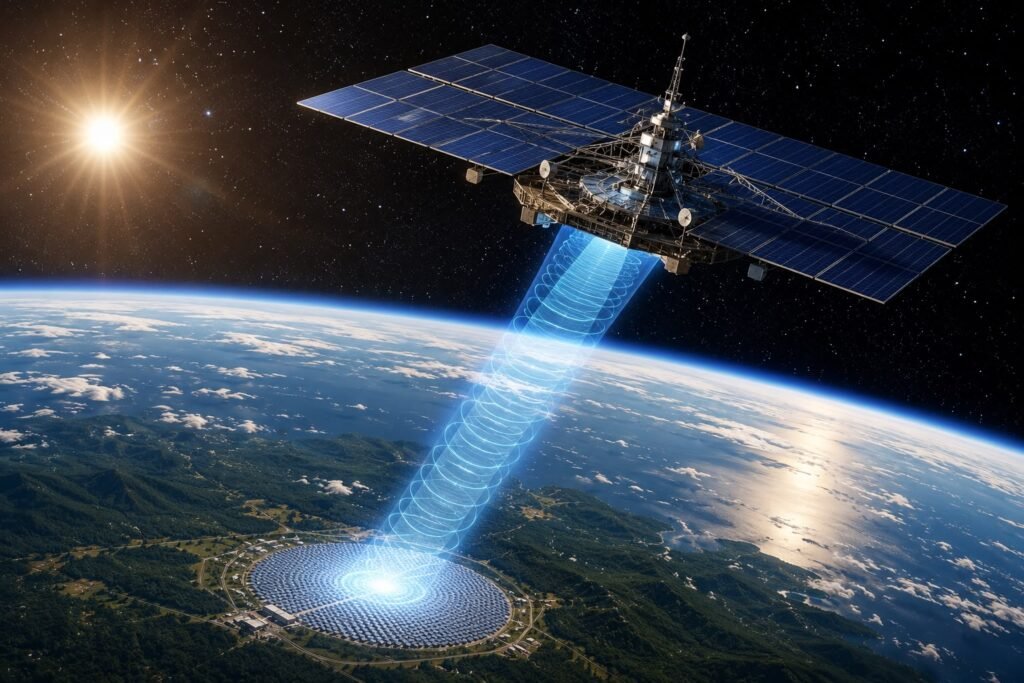
Imagine waking up one morning and discovering that your home is being powered by sunlight collected hundreds of kilometers above Earth. No power plants, No coal, No cloudy weather interruptions, No sunset. Just a constant stream of clean energy arriving from space.
It sounds like something straight out of a futuristic science-fiction movie, but scientists in Japan are actively working to make this vision a reality. For decades, researchers have dreamed about collecting solar energy in space and transmitting it back to Earth. Now, thanks to major technological advances, Japan is moving closer than ever to turning that dream into one of the biggest energy revolutions in human history.
Introduction : The Birth of Space-Based Solar Power
Solar panels have become one of the world’s fastest-growing sources of clean energy. However, traditional solar power has a major weakness. Solar panels only work when sunlight reaches them. Clouds, storms, seasonal changes, and nighttime all reduce energy production.
This limitation forces countries to rely on batteries, backup power plants, and expensive energy infrastructure. Scientists began asking an extraordinary question: What if solar panels could be placed above Earth’s atmosphere where sunlight shines almost continuously?
This idea became known as Space-Based Solar Power (SBSP). Today, Japan’s space agency JAXA and several research organizations are investing heavily in technologies that could make space power stations a reality. If successful, humanity could gain access to an almost unlimited source of clean energy.
The Breakthrough : Turning Science Fiction Into Engineering
The concept of space solar power has existed since the 1960s, but it remained impractical for decades. Launching massive solar power stations into orbit was simply too expensive. Transmitting electricity across space also seemed nearly impossible. Recent advances in reusable rockets, lightweight materials, wireless power transmission, and satellite technology have changed the equation.
Japanese researchers have already demonstrated wireless energy transmission experiments and continue testing systems capable of sending electricity over long distances without physical cables.
The ultimate goal is ambitious:
Build giant solar farms in orbit, collect energy from the Sun, convert that energy into microwaves or radio waves, and beam it safely back to receiving stations on Earth. For many scientists, this represents one of the most exciting energy projects of the 21st century.
The Science Behind It : Why Space Is the Perfect Solar Power Plant ?
To understand why scientists are excited, we first need to understand a simple problem. Earth’s atmosphere blocks and scatters part of the Sun’s energy. Clouds further reduce sunlight reaching solar panels. Nighttime stops power generation entirely.
In space, none of these problems exist. A satellite orbiting Earth receives nearly uninterrupted sunlight for most of its journey. This means orbital solar panels can generate significantly more electricity than identical panels on Earth’s surface.
The process works through four major steps:
1} Solar Collection : Gigantic solar arrays capture sunlight directly in space.
2} Energy Conversion : The collected energy is converted into microwaves or radio-frequency energy.
3} Wireless Transmission : Special antennas beam the energy toward Earth.
4} Ground Reception : Large receiving stations called rectennas capture the energy and convert it back into electricity. The result is continuous renewable energy without dependence on weather conditions.
How Does It Work?
The complete system operates like a giant power station floating above our planet.
Step 1: Launching Solar Satellites
Large solar power satellites are placed into orbit using powerful rockets.
Step 2: Harvesting Solar Energy
Massive solar arrays absorb sunlight and generate electricity.
Step 3: Converting Electricity Into Microwaves
The electrical energy powers microwave transmitters.
Step 4: Beaming Energy to Earth
A focused microwave beam travels through the atmosphere toward designated receiving stations.
Step 5: Converting Energy Back Into Electricity
Ground-based rectennas convert the incoming microwaves back into usable electricity for homes, businesses, and industries. The entire process occurs without wires stretching between Earth and space.
Why This Could Change Everything ?
Energy powers modern civilization. Every factory, hospital, computer, vehicle, and city depends on reliable electricity.
Space-based solar power could solve several major challenges facing humanity.
1} Unlimited Clean Energy – Unlike fossil fuels, sunlight is renewable. The Sun delivers more energy to Earth every hour than humanity uses in an entire year.
2} No Weather Dependence – Traditional solar farms suffer during storms and cloudy days. Space solar stations operate above the weather.
3} Reduced Carbon Emissions – Replacing fossil fuel power plants with clean space energy could dramatically reduce greenhouse gas emissions.
4} Energy for Remote Areas – Electricity could potentially be delivered to isolated regions where building traditional infrastructure is difficult.
5} Greater Energy Security – Countries could reduce dependence on imported fossil fuels and unstable energy markets. The Global Race for Space Energy Japan is not the only nation pursuing this technology. Several countries and organizations are investing heavily in space-based solar power research.
The United States, China, the United Kingdom, and the European Space Agency are all exploring similar concepts. China has announced plans for large-scale orbital solar power demonstrations in the coming years. The United Kingdom has funded studies examining commercial space solar power systems.
Meanwhile, Japanese researchers remain among the pioneers in wireless energy transmission technology. Many experts believe the first nation to successfully deploy space solar power could gain enormous economic and technological advantages.
Challenges Standing in the Way : Despite its enormous potential, major obstacles remain.
1. Cost
Launching large structures into orbit remains extremely expensive. Although rocket costs have fallen dramatically, building giant orbital power stations would require significant investment.
2. Efficiency
Scientists must improve the efficiency of wireless energy transmission to minimize losses.
3. Space Construction
Future power stations may be larger than football stadiums. Building such structures in orbit presents major engineering challenges.
4. Safety Concerns
Engineers must ensure microwave beams remain safe for humans, aircraft, wildlife, and satellites.
5. Maintenance
Repairing equipment hundreds of kilometers above Earth is far more difficult than repairing infrastructure on the ground.
6. Future Possibilities
If space-based solar power succeeds, it could transform civilization.
Future generations may witness:
- Orbital solar farms producing gigawatts of electricity.
- Wireless energy networks connecting continents.
- Clean energy powering billions of people.
- Lunar bases receiving electricity from orbital solar stations.
- Deep-space missions fueled by energy collected directly from sunlight.
Some scientists even envision massive solar power stations supporting future colonies on the Moon and Mars. What seems futuristic today could become ordinary within the next few decades.
Conclusion :
The Beginning of Humanity’s Space Energy Era For thousands of years, humanity has depended on energy sources found on Earth. Coal powered the Industrial Revolution. Oil transformed transportation. Nuclear energy unlocked incredible new possibilities.
Now, a new chapter may be beginning. Japan’s efforts to generate electricity from space represent one of the boldest technological visions ever attempted. If scientists succeed, future generations may look back on this moment as the beginning of humanity’s space energy era.
Today, it is becoming an engineering challenge rather than a fantasy. And if that challenge is solved, the future of energy may quite literally come from the stars.
Sources :
JAXA (Japan Aerospace Exploration Agency)
https://global.jaxa.jp
Japan Space Systems (JSS)
https://www.jspacesystems.or.jp
NASA Space-Based Solar Power Research
https://www.nasa.gov
European Space Agency (ESA)
https://www.esa.int
IEEE Spectrum – Space Solar Power Technology
https://spectrum.ieee.org
Nature Energy
https://www.nature.com/nenergy
Reuters – Japan Space Solar Power Developments
https://www.reuters.com