

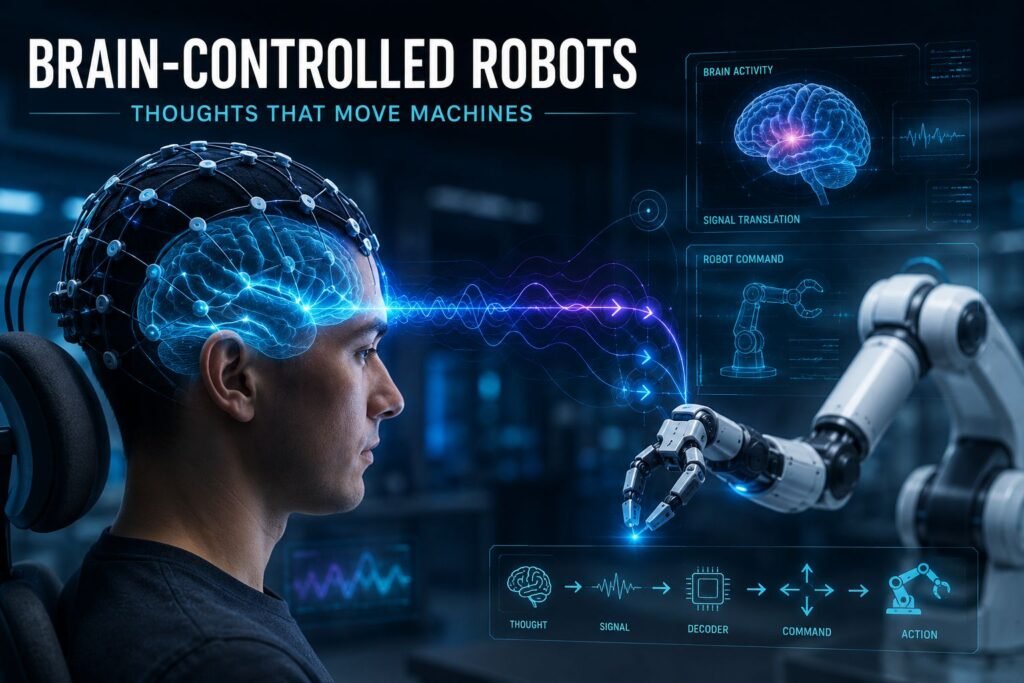
Imagine sitting on your couch and looking at a cup of coffee across the room. Suddenly, a robotic arm reaches out, grabs the cup, and brings it directly to you. You didn’t move your hands. You didn’t speak a single word. You simply thought about it.
For decades, this idea belonged to science fiction movies and superhero stories. Today, it is becoming a scientific reality. Thanks to rapid advances in Brain-Computer Interfaces (BCIs), scientists are creating robots that can be controlled directly by the human mind. What once seemed impossible is now happening inside laboratories, hospitals, and research centers around the world.
The Dawn of the Thought-Controlled Era Brain-controlled robots are machines that can receive commands directly from human brain activity. They rely on a revolutionary technology known as a Brain-Computer Interface, or BCI. A BCI acts like a translator between the human brain and a machine. Instead of using keyboards, touchscreens, or voice commands, users communicate with technology through their thoughts.
Recent breakthroughs from companies such as Neuralink, Synchron, and several leading universities have dramatically improved the speed and accuracy of these systems. Scientists now believe that we may be entering a new era where humans and machines can work together in ways that were once unimaginable.
The Breakthrough That Is Changing Everything
Over the last few years, BCI technology has advanced at an astonishing pace. Researchers have successfully enabled paralyzed patients to move robotic arms, control computer cursors, play video games, and even communicate through digital devices using only their thoughts. In some experiments, patients who had lost the ability to speak were able to generate text and communicate at near-conversational speeds simply by imagining words and sentences.
The biggest reason for this progress is artificial intelligence. Human brain signals are incredibly complex. Every second, billions of neurons generate electrical activity that can appear chaotic and difficult to understand. Modern AI systems can analyze these signals, identify meaningful patterns, and convert them into commands almost instantly. What once looked like random electrical noise is now becoming a powerful communication channel between humans and machines.
The Science Behind Brain-Controlled Robots :
To understand how this technology works, we first need to understand the human brain. The brain contains approximately 86 billion neurons. These specialized cells communicate through tiny electrical and chemical signals. Every action you perform begins inside your brain.
Whether you want to move your hand, blink your eyes, or pick up a glass of water, a unique pattern of electrical activity appears inside specific regions of the brain. Scientists have developed several methods to capture these signals. Invasive Neural Implants These devices are surgically placed near or on the brain.
Tiny electrodes detect electrical activity directly from neurons, providing highly detailed information. Technologies such as Neuralink’s implant use extremely thin threads that can record signals from thousands of neurons simultaneously. Minimally Invasive Systems Some devices avoid open-brain surgery by traveling through blood vessels and positioning themselves close to brain tissue.
These systems can capture neural activity while reducing surgical risks. Non-Invasive Brain Sensors Electroencephalography (EEG) headsets sit on the scalp and measure brain activity without surgery. Although they provide lower-resolution data, they are safer and easier to use. Once the signals are collected, artificial intelligence takes over.
Machine-learning algorithms analyze the incoming data, identify patterns associated with specific thoughts, and convert them into digital commands that a computer can understand.
How Does It Work?
The entire process happens within fractions of a second.
Step 1: The Brain Creates an Intention
Imagine that you want a robotic arm to pick up an apple. The motor cortex inside your brain generates a specific pattern of electrical activity associated with that movement.
Step 2: Sensors Detect Brain Signals
Electrodes or sensors capture the electrical signals produced by neurons. These signals are then transmitted to a computer.
Step 3: Artificial Intelligence Decodes the Pattern
AI algorithms analyze the incoming neural activity. After training on thousands of examples, the system learns which patterns correspond to actions such as moving left, moving right, grabbing an object, or typing a letter.
Step 4: The Computer Generates Commands
The decoded intention is converted into software instructions.
For example:
“Move arm forward.” “Close robotic hand.” “Lift object.”
Step 5: The Robot Performs the Action
The robot receives the command and executes the movement in real time. From the user’s perspective, it feels almost as if the robot has become an extension of their own body. Real-World Applications Brain-controlled robotics is already transforming lives.
Restoring Independence For people living with paralysis or severe spinal cord injuries, BCIs can provide a new way to interact with the world. Robotic arms allow users to perform everyday tasks that were previously impossible. Giving Patients a Voice
Individuals suffering from conditions such as ALS often lose the ability to speak. New brain-computer systems can decode intended speech and convert it into text or synthetic voice output. Smart Wheelchairs Thought-controlled wheelchairs could allow users with severe mobility limitations to navigate their surroundings safely and independently.
Industrial Robotics Workers may eventually control complex machines remotely through neural interfaces, reducing exposure to dangerous environments. Space Exploration Future astronauts could operate robotic systems on the Moon, Mars, or distant space stations using thought-based commands, improving efficiency and precision.
The Social Impact-
The potential impact of this technology extends far beyond robotics. Millions of people worldwide live with disabilities that limit communication or movement. Brain-controlled systems could help restore independence, improve quality of life, and create opportunities that were previously unavailable.
Healthcare systems may also change dramatically. Future rehabilitation programs could focus on retraining the brain and strengthening neural connections through advanced BCI technologies. In many ways, brain-controlled robotics represents one of the most important accessibility breakthroughs of the modern era.
What Could the Future Look Like?
Researchers believe today’s systems are only the beginning. Future developments may include robotic prosthetic limbs capable of providing a realistic sense of touch. Scientists are also exploring thought-controlled smart homes where users can operate lights, doors, appliances, and computers using only their minds.
As technology improves, humans and robots may collaborate more closely than ever before. Some researchers even envision direct brain-to-computer communication systems that could dramatically change how people interact with technology.
Challenges and Ethical Concerns:
Despite its enormous promise, brain-controlled robotics raises important questions. Privacy Brain signals contain highly personal information. Protecting neural data may become one of the biggest privacy challenges of the future.
Cybersecurity Any connected system can potentially be hacked. Ensuring the safety of brain-controlled devices will require strong security measures. Accessibility Many current systems are expensive and available only through research programs. Making these technologies affordable will be essential for widespread adoption.
Ethics As humans become more connected to machines, society will need to address important ethical questions about identity, autonomy, and the limits of human enhancement.
Conclusion
Brain-controlled robots are proving that the human mind is far more powerful than we once imagined. By connecting thoughts directly to machines, scientists are creating technologies that could restore mobility, improve communication, and transform the relationship between humans and technology.
The dream of controlling machines with nothing but thought is no longer science fiction. It is happening right now. And as brain-computer interfaces continue to evolve, we may soon enter a future where the boundary between mind and machine becomes almost invisible.
Sources:-
Nature Electronics
https://www.nature.com/natelectron
Science (AAAS)
https://www.science.org
MIT Technology Review
https://www.technologyreview.com
IEEE Spectrum
https://spectrum.ieee.org
National Institutes of Health (NIH)
https://www.nih.gov
Neuralink
https://neuralink.com
Synchron
https://synchron.com