

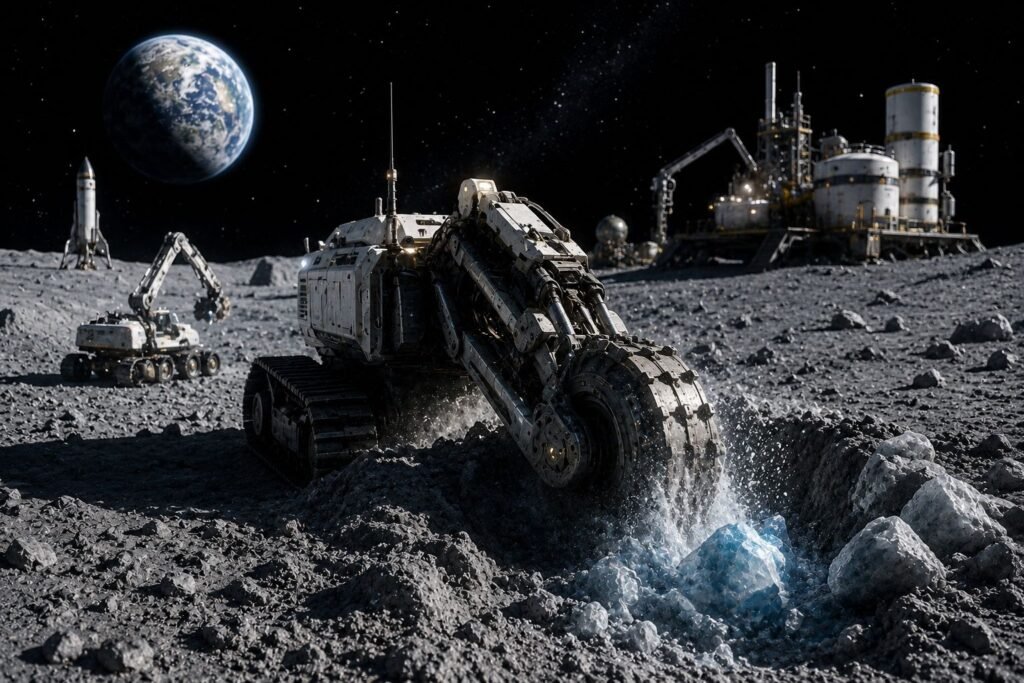
For centuries, humanity has searched Earth for valuable resources—gold, oil, diamonds, and rare metals. But what if the next great mining boom doesn’t happen on our planet at all?
What if it happens 384,400 kilometers away on the Moon?
That idea may sound like science fiction, but it is quickly becoming a serious scientific and economic reality. Governments, space agencies, and private companies are now investing billions of dollars into technologies that could one day extract valuable resources directly from the lunar surface.
The race to mine the Moon has officially begun. The Birth of Lunar Mining Moon mining refers to the process of extracting useful resources from the lunar surface and using them to support future space exploration. For decades, the Moon was viewed primarily as a destination for exploration. Astronauts visited, collected samples, conducted experiments, and returned home.
Today, the vision has changed dramatically. Scientists no longer see the Moon as a barren wasteland. Instead, they view it as a resource-rich world that could provide water, oxygen, fuel, construction materials, and possibly even future energy sources. Rather than carrying everything from Earth, future explorers may be able to use resources already available on the Moon.
This concept is known as In-Situ Resource Utilization (ISRU), and it is becoming one of the most important goals of modern space exploration.
The Breakthrough That Changed Everything
The current excitement surrounding lunar mining comes from one crucial discovery: water ice. Over the past two decades, missions from NASA, ISRO, ESA, CNSA, and JAXA have gathered strong evidence that significant amounts of water ice exist inside permanently shadowed craters near the Moon’s poles. These craters never receive direct sunlight and remain among the coldest places in the Solar System.
Scientists believe these frozen reservoirs contain enough water to support future lunar missions and potentially permanent settlements. The discovery transformed the Moon from an interesting scientific target into a strategic resource hub. Today, space agencies are actively developing technologies designed to locate, extract, and process these resources directly on the lunar surface.
What Exactly Is Hidden Beneath Lunar Dust?
The Moon is covered by a layer of fine material known as regolith. At first glance, it appears to be nothing more than gray dust and broken rock. However, hidden within this seemingly ordinary material are resources that could reshape humanity’s future in space.
Water Ice : Water is arguably the most valuable resource on the Moon. It can be used for drinking, growing food, producing breathable oxygen, and manufacturing rocket fuel. Without water, long-term human presence on the Moon would be nearly impossible.
Oxygen : Many people are surprised to learn that oxygen is abundant on the Moon. The challenge is that it is chemically bound inside minerals and rocks. Scientists are developing methods to extract this oxygen for future astronauts.
Metals : Lunar regolith contains useful metals including iron, titanium, aluminum, and silicon. These materials could be used to manufacture tools, infrastructure, and spacecraft components directly on the Moon.
Helium-3 : Perhaps the most famous lunar resource is Helium-3. This rare isotope is extremely scarce on Earth but may exist in larger quantities on the Moon. Some scientists believe it could play a role in future nuclear fusion reactors, although practical commercial fusion remains a long-term challenge.
How Does Moon Mining Actually Work?
Mining on the Moon is far more complicated than mining on Earth. There is no breathable atmosphere, temperatures are extreme, and every operation must function in a hostile environment. Scientists envision a largely robotic mining system.
Step 1: Landing Robotic Equipment – Autonomous spacecraft would deliver rovers, excavators, drills, and processing units to the lunar surface.
Step 2: Collecting Lunar Soil – Robotic machines would gather large amounts of regolith and transport it to processing facilities.
Step 3: Resource Extraction – The material would be heated or chemically processed to release oxygen, water vapor, and other useful substances.
Step 4: Storage and Conversion – Extracted resources would be stored for future use. Water could be purified for drinking or separated into hydrogen and oxygen.
Step 5: Fuel Production – Hydrogen and oxygen can be combined to create rocket propellant, enabling spacecraft to refuel beyond Earth. This capability could fundamentally transform space travel.
Why Water on the Moon Is More Valuable Than Gold?
Gold may be valuable on Earth, but in space, water is far more important. Every kilogram launched from Earth requires enormous amounts of fuel and money. Transporting water into space is extremely expensive. If astronauts can obtain water directly from the Moon, future missions become dramatically cheaper and more sustainable.
Water can support human life. It can create breathable oxygen. It can also become rocket fuel. In many ways, water is the foundation of a future space economy.
1] Real-World Applications : The resources extracted from the Moon could support a wide range of ambitious projects.
2] Permanent Lunar Bases : Future astronauts could live for months or even years using locally produced water and oxygen.
3] Fuel Depots in Space : The Moon could become a refueling station for spacecraft traveling deeper into the Solar System.
4] Mars Missions : Future missions to Mars may launch from lunar orbit rather than directly from Earth, reducing costs and increasing efficiency.
5] Space Manufacturing : Factories in space could use lunar materials to build satellites, habitats, and spacecraft without relying entirely on Earth-based supply chains.
6] 3D-Printed Infrastructure : Researchers are exploring ways to use lunar soil as a construction material for roads, landing pads, and protective habitats.
The Economic and Social Impact :-
If lunar mining becomes successful, it could create entirely new industries. Engineers, robotic operators, materials scientists, software developers, and space logistics specialists may all play roles in a growing space economy. Some experts believe the space economy could eventually be worth trillions of dollars.
At the same time, international competition is increasing. The nations that establish an early presence on the Moon may gain significant technological and economic advantages. This has transformed lunar exploration into one of the most important geopolitical competitions of the century.
1] The Challenges Ahead – Despite the excitement, major obstacles remain.
2] Extreme Temperatures – Lunar temperatures can range from over 120°C in sunlight to below -170°C in darkness.
3] Dangerous Dust – Lunar dust is abrasive and can damage equipment, seals, and machinery.
4] Radiation Exposure – Without a protective atmosphere, astronauts and equipment face constant radiation threats.
5] High Costs – Building, launching, and maintaining lunar infrastructure remains extremely expensive.
6] Legal Uncertainty – International treaties prevent countries from claiming ownership of the Moon itself, raising questions about resource rights and commercial operations.
A Future Beyond Earth :-
Imagine looking up at the Moon a few decades from now. Instead of seeing a silent, lifeless world, you might be looking at a thriving center of human activity. Robotic mining operations could extract resources around the clock.
Scientific outposts could host researchers year-round. Fuel depots could support missions to Mars and beyond. Factories might manufacture spacecraft using materials sourced directly from the lunar surface. The Moon could become humanity’s gateway to the Solar System.
Conclusion
Moon mining is about much more than extracting resources. It represents a fundamental shift in how humanity approaches space exploration. For the first time in history, we are seriously preparing to live off the resources of another world.
If successful, lunar mining could provide the foundation for permanent settlements, interplanetary travel, and an entirely new space economy. The race is no longer about simply reaching the Moon. It is about building the future there.
Sources :
NASA – Artemis Program & ISRU Research
https://www.nasa.gov
European Space Agency (ESA) – Lunar Resource Utilization
https://www.esa.int
ISRO – Chandrayaan Discoveries
https://www.isro.gov.in
JAXA – Lunar Exploration Program
https://global.jaxa.jp
Nature Astronomy
https://www.nature.com/natureastronomy
Science Journal
https://www.science.org