

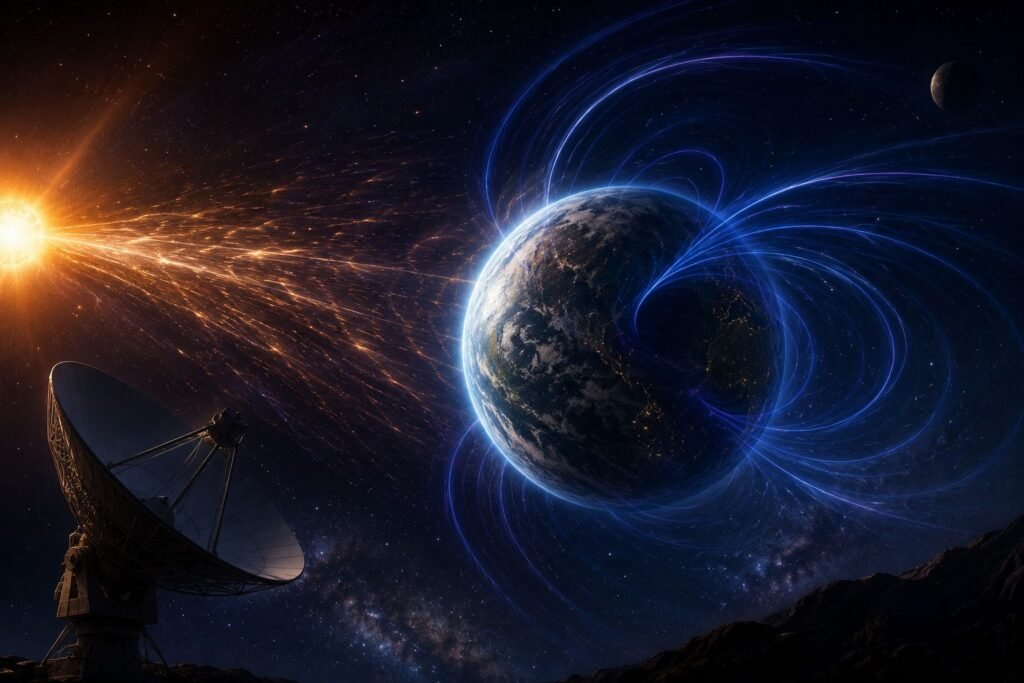
Imagine looking at a planet hundreds of light-years away and discovering that it possesses an invisible shield protecting it from deadly cosmic radiation. Now imagine finding not one such planet—but seven.
That is exactly what happened when astronomers recently made an unexpected discovery while studying distant exoplanets. In what many scientists are calling a major breakthrough, researchers accidentally detected magnetic fields around seven alien worlds, opening an entirely new pathway in the search for habitable planets beyond our Solar System.
The discovery is exciting because magnetic fields play a crucial role in protecting planets and potentially supporting life. While scientists have discovered thousands of exoplanets over the past three decades, detecting magnetic fields around them has remained one of astronomy’s greatest challenges.
Now, for the first time, researchers may finally have a way to identify which distant worlds possess these invisible planetary shields.
Introduction : Why Magnetic Fields Matter ?
When most people think about the ingredients needed for life, they usually imagine water, oxygen, and a suitable temperature. However, there is another requirement that is often overlooked protection. Life on Earth survives because our planet is surrounded by a powerful magnetic field generated deep within its molten core.
This magnetic field acts like a giant invisible force field, protecting Earth from harmful charged particles constantly blasted into space by the Sun. Without this protection, Earth’s atmosphere would gradually erode and the surface would be bombarded by dangerous radiation. Scientists believe this magnetic shield has played a critical role in allowing life to thrive on our planet for billions of years.
That is why the discovery of magnetic fields around distant exoplanets is generating so much excitement.
The Breakthrough : An Accidental Discovery
The discovery was not originally planned. Astronomers were studying signals coming from distant planetary systems when they noticed unusual bursts of radio emissions. At first, the signals appeared puzzling.
However, after detailed analysis, researchers realized that these radio waves were likely being produced by interactions between stellar winds and planetary magnetic fields. In simple terms, scientists may have accidentally detected evidence of invisible magnetic shields surrounding seven different exoplanets.
This is a significant breakthrough because magnetic fields are incredibly difficult to observe directly. Unlike stars, planets do not emit enough light for scientists to easily study their internal structures. As a result, astronomers have spent years searching for indirect ways to identify planetary magnetic fields.
This new technique may finally provide that opportunity.
The Science Behind It : Planetary Force Fields
To understand the importance of this discovery, we first need to understand how magnetic fields are created. Inside planets like Earth, molten metals continuously move and circulate within the core. These moving electrically charged materials generate magnetic fields through a process known as the dynamo effect.
The result is an invisible bubble surrounding the planet called the magnetosphere. This protective shield extends thousands of kilometers into space. When charged particles from a nearby star collide with the magnetosphere, they become trapped or deflected.
Earth experiences this phenomenon every day. In fact, the beautiful Northern and Southern Lights are partially created by interactions between solar particles and Earth’s magnetic field. Scientists believe similar processes may be occurring on these newly studied alien worlds.
How Did Scientists Detect Something Invisible?
Detecting magnetic fields across interstellar distances sounds impossible. The secret lies in radio waves. When charged particles from a star slam into a planet’s magnetic field, they can generate powerful radio emissions. Astronomers use giant radio telescopes to listen for these signals.
The process works like this:
Step 1: Observe Distant Planetary Systems
Scientists monitor stars known to host exoplanets.
Step 2: Search for Radio Signals
Sensitive radio telescopes scan for unusual bursts of radio energy.
Step 3: Analyze Signal Patterns
Researchers examine the strength, frequency, and timing of the emissions.
Step 4: Compare with Computer Models
The observed signals are compared with simulations of star-planet magnetic interactions.
Step 5: Infer Magnetic Fields
If the data matches theoretical predictions, scientists can estimate the presence and strength of a planetary magnetic field. This method provides one of the most promising ways yet discovered to study planetary magnetism beyond our Solar System.
Why This Discovery Is So Important ?
Finding a planet is one thing. Finding a potentially habitable planet is much harder. A world may have water, a suitable atmosphere, and Earth-like temperatures. But without a magnetic field, it could still be exposed to intense stellar radiation.
That radiation can gradually strip away an atmosphere and make the surface hostile to life. This is one reason scientists often compare Earth and Mars. Billions of years ago, Mars likely had liquid water and a thicker atmosphere. However, Mars lost most of its global magnetic field.
Without that protection, the solar wind slowly eroded much of the Martian atmosphere. Today, Mars is a cold, dry world. This comparison highlights why magnetic fields may be one of the most important factors in planetary habitability.
What Could This Mean for Alien Life?
The discovery does not prove that life exists on any of these planets. However, it dramatically improves scientists’ ability to identify promising candidates.
1} Better Targets for Future Telescopes
Future observatories can focus on planets that possess magnetic fields, increasing the chances of finding habitable environments.
2} Improved Habitability Studies
Researchers can combine magnetic field data with information about atmospheres, temperatures, and planetary composition.
3} Understanding Planetary Evolution
Studying magnetic fields helps scientists understand how planets form, evolve, and maintain their atmospheres over billions of years.
4} Expanding the Search for Life
The discovery adds a completely new tool to humanity’s growing arsenal in the search for extraterrestrial life.
Future Possibilities : A New Era of Exoplanet Science Astronomers believe this breakthrough could mark the beginning of a new era. Until now, scientists primarily searched for planets based on size, mass, temperature, and distance from their stars.
In the future, magnetic fields may become another crucial habitability indicator. Upcoming observatories such as the Nancy Grace Roman Space Telescope, the Extremely Large Telescope, and future radio telescope arrays could use similar techniques to study hundreds or even thousands of alien worlds. Researchers may eventually create the first large-scale catalog of magnetic exoplanets.
Such a database could dramatically improve our chances of identifying truly Earth-like planets.
Challenges and Limitations :
Despite the excitement, several questions remain. The detected signals are still being studied and interpreted. Scientists must confirm that the radio emissions are indeed caused by planetary magnetic fields and not other astrophysical phenomena.
Additionally, detecting radio signals from distant planets remains extremely difficult. Many exoplanets are simply too far away or too faint for current instruments. Future telescopes will be needed to fully unlock the potential of this technique. As with any major scientific discovery, further observations and independent confirmation will be essential.
Conclusion :
The Invisible Clue That Could Lead to Alien Life. For decades, astronomers have searched for signs that distant worlds might resemble Earth. They have looked for water, atmospheres, and suitable temperatures. Now they may have found another critical clue: magnetic fields. The accidental detection of magnetic fields around seven alien planets represents far more than a technical achievement.
It gives scientists a powerful new way to identify worlds capable of protecting their atmospheres and potentially supporting life. The planets themselves remain mysterious. We do not know whether oceans exist there. We do not know whether life has emerged.
But for the first time, we may have discovered evidence that some distant worlds possess one of the most important ingredients that helped make Earth habitable. And that brings humanity one step closer to answering one of the biggest questions in science: Are we alone in the universe?
Sources :
Live Science
https://www.livescience.com
Nature Astronomy
https://www.nature.com/natureastronomy
NASA Exoplanet Exploration Program
https://exoplanets.nasa.gov
European Southern Observatory (ESO)
https://www.eso.org