
When most people think about celebrities receiving massive awards, they picture movie stars walking down red carpets, musicians accepting trophies, or athletes celebrating championship victories.
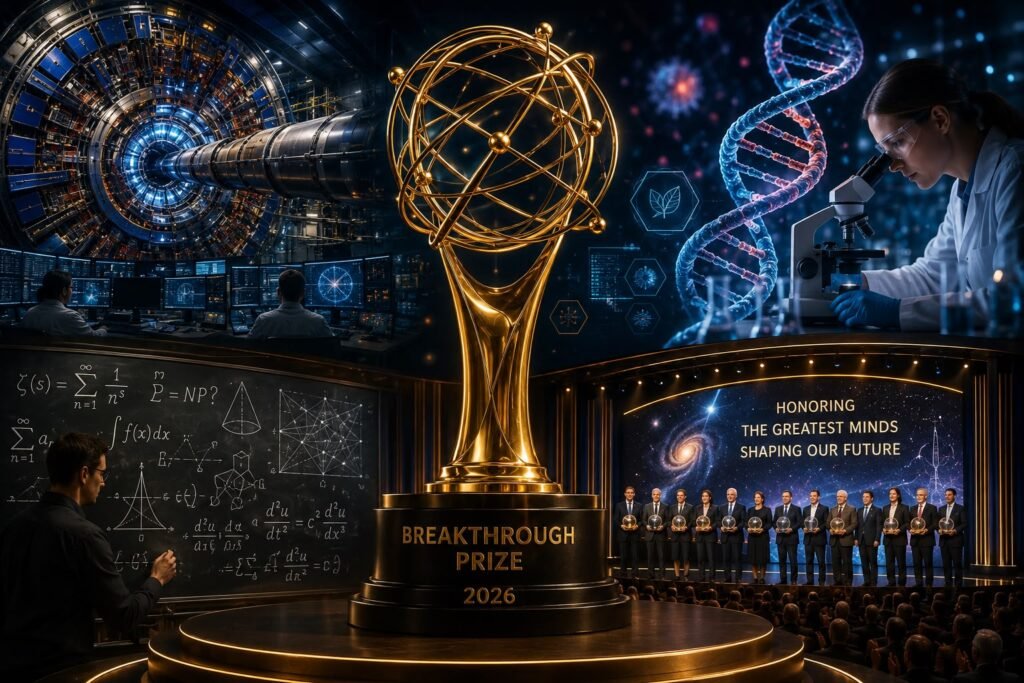
But every year, another group of people receives awards that are often even more valuable—and their work could have a far greater impact on humanity. These people are scientists. And the award is called the Breakthrough Prize, often referred to as the “Oscars of Science.”
In 2026, researchers from around the world shared more than $18 million in prize money for discoveries that are helping humanity understand the universe, fight disease, and unlock some of the deepest mysteries of nature. While Hollywood creates stories for entertainment, these scientists are helping write the next chapter of human civilization.
Introduction :
Science’s Most Prestigious Celebration, The Breakthrough Prize was established in 2012 by several influential technology entrepreneurs, including leaders from Silicon Valley. Their vision was simple but powerful. Scientists change the world every day, yet they rarely receive the same level of public recognition as actors, musicians, or sports stars.
The founders wanted to change that. Today, the Breakthrough Prize is one of the most prestigious scientific awards on Earth.
Each year, prizes are awarded in three major categories:
1. Life Sciences
2. Fundamental Physics
3. Mathematics
The winners receive millions of dollars and international recognition for achievements that expand humanity’s understanding of reality itself. Unlike many traditional awards, the Breakthrough Prize focuses on scientific discoveries that could shape the future of our species.
The Breakthrough : Why This Year’s Awards Matter
The 2026 Breakthrough Prize winners represent some of the most important scientific achievements of recent years. Researchers involved in major particle physics experiments were honored for helping scientists understand the fundamental particles and forces that make up our universe.
Other winners were recognized for breakthroughs in genetics, disease research, and mathematical theories that could eventually influence future technologies. Many of these discoveries may sound highly technical today. However, history shows that fundamental science often leads to revolutionary innovations.
Research once considered purely theoretical eventually gave rise to GPS navigation, smartphones, lasers, medical imaging, and the internet. The discoveries being celebrated today could become the technologies that define tomorrow.
The Science Behind Scientific Breakthroughs :-
Many people imagine scientific discoveries happening through sudden moments of inspiration. The reality is very different. Modern breakthroughs often require years or even decades of work. Large scientific projects frequently involve thousands of researchers spread across dozens of countries.
Particle physicists analyze enormous amounts of data generated by powerful accelerators. Biologists study complex interactions inside living cells. Mathematicians spend years developing theories that may eventually solve practical engineering challenges. Scientific progress is often slow, difficult, and filled with failures.
A single successful breakthrough may be built upon decades of previous research. The Breakthrough Prize recognizes this extraordinary dedication.
How Does Modern Scientific Research Work? The process behind a major scientific discovery usually follows several key stages.
Step 1: Observation
Scientists identify a problem or unexplained phenomenon.
Step 2: Hypothesis
Researchers develop theories that may explain the observations.
Step 3: Experimentation
Carefully designed experiments test those theories.
Step 4: Data Analysis
Scientists analyze enormous amounts of information to determine whether their ideas are correct.
Step 5: Peer Review
Independent experts verify the findings before they are accepted by the scientific community. Only after surviving this rigorous process does a discovery become part of scientific knowledge. The achievements honored by the Breakthrough Prize represent some of the most successful examples of this process.
Why Scientific Awards Matter ?
At first glance, awarding millions of dollars to scientists might seem unnecessary. However, these prizes serve several important purposes. First, they encourage scientific innovation. Major discoveries often require years of dedication with no guarantee of success.
Recognition helps motivate researchers to continue tackling difficult problems. Second, awards bring public attention to important scientific work. Many groundbreaking discoveries occur far from public view. The Breakthrough Prize helps highlight achievements that might otherwise go unnoticed.
Third, these awards inspire future generations. Young students watching scientists receive global recognition may become the researchers, engineers, and innovators of tomorrow. The Real-World Impact of Fundamental Research
Some people question whether basic scientific research produces tangible benefits. History provides a clear answer.
The answer is yes.
Albert Einstein’s theories eventually became essential for GPS technology. Quantum physics helped create modern computers and smartphones. Genetics research transformed medicine. Space exploration produced technologies used in countless industries.
Many of today’s most important inventions originated from research that initially appeared to have little practical value. Fundamental science often plants seeds that bloom decades later. That is why discoveries celebrated today may become everyday technologies in the future.
The Future of Scientific Discovery :
Humanity is entering one of the most exciting scientific periods in history. Researchers are investigating some of the biggest mysteries ever encountered. Scientists are searching for dark matter, the invisible substance believed to make up much of the universe. Biologists are developing new treatments for cancer, Alzheimer’s disease, and genetic disorders.
Engineers are building quantum computers that could revolutionize computing. Astronomers are searching for habitable worlds beyond our solar system. Artificial intelligence is accelerating scientific research across nearly every field. Many experts believe the next twenty years could produce discoveries comparable to the scientific revolutions of the twentieth century.
Challenges Facing Modern Science ?
Despite incredible progress, scientists face significant obstacles, Research is expensive, Large projects often require billions of dollars in funding, Some experiments take decades to complete, Scientific misinformation can also create public confusion about important discoveries.
Additionally, many of the world’s biggest challenges—including climate change, emerging diseases, and energy production—require international cooperation. Addressing these issues will demand collaboration between scientists, governments, and industries worldwide.
Conclusion : Celebrating Humanity’s Greatest Explorers
Throughout history, explorers crossed oceans to discover new lands. Today, scientists explore something even greater. They explore reality itself. Their discoveries reveal how the universe works, how life functions, and how humanity can build a better future.
The Breakthrough Prize celebrates these modern explorers. It reminds us that some of the most important adventures do not happen on movie screens or sports fields. They happen inside laboratories, observatories, research centers, and universities around the world. The scientists receiving these awards may not be household names.
But their discoveries have the power to change the future of civilization. And that is why the “Oscars of Science” may be the most important awards on Earth.
Sources :
Breakthrough Prize
https://breakthroughprize.org
Nature
https://www.nature.com
Science
https://www.science.org
American Physical Society
https://www.aps.org
National Academy of Sciences
https://www.nasonline.org
The Kavli Foundation
https://www.kavlifoundation.org