

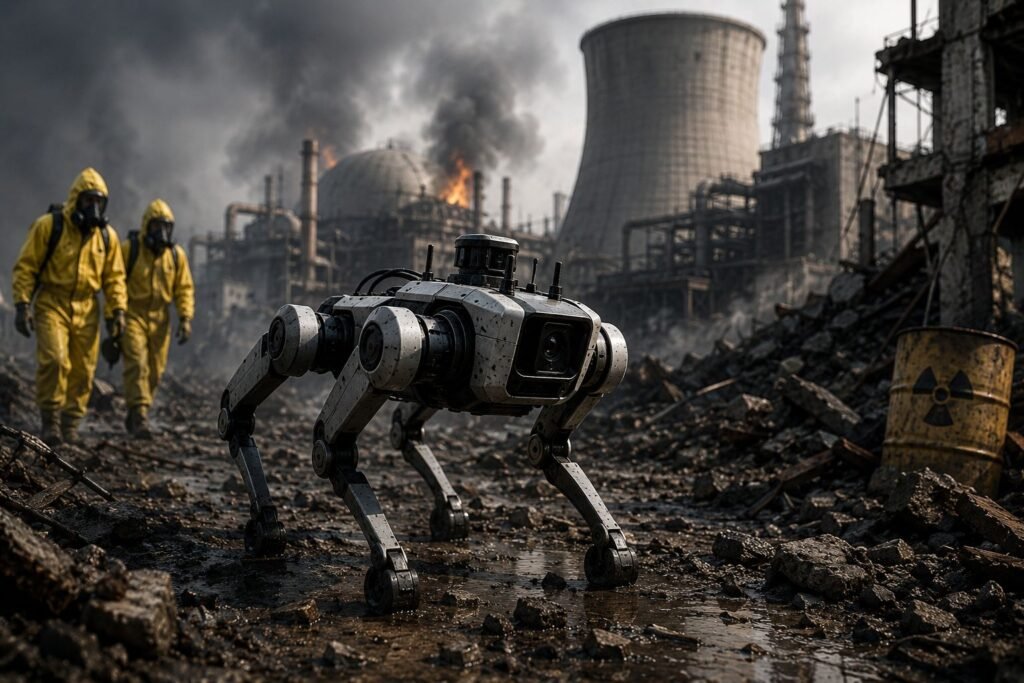
A massive earthquake strikes an industrial city. Buildings collapse. Roads crack apart. A nearby chemical plant suffers severe damage, releasing toxic gases into the air. Emergency crews arrive quickly, but there is a problem. The environment is simply too dangerous.
The air is contaminated. The structures are unstable. Every step could trigger another collapse. Sending human rescuers inside could cost lives. But then, something unusual enters the disaster zone. A four-legged machine walks calmly through the rubble.
It doesn’t breathe toxic air. It doesn’t fear radiation. It doesn’t panic under pressure. Instead, it scans the environment, maps the terrain, and searches for survivors. This isn’t science fiction. It’s happening right now.
Robot dogs are becoming some of the most valuable tools in modern emergency response, industrial inspection, and scientific exploration. And many experts believe they could become the first responders of the future.
The Rise of a New Kind of Robot
Robot dogs are advanced four-legged machines designed to move like animals. Unlike traditional wheeled robots, which struggle with stairs, debris, and uneven terrain, robot dogs can walk, climb, balance, and adapt to challenging environments. Their design is inspired by nature.
Animals have evolved over millions of years to move efficiently across rough terrain. Engineers are now applying those same principles to robotics. The result is a machine capable of reaching places where wheels often fail. Over the last decade, these robots have evolved from laboratory experiments into real-world industrial tools.
Today, governments, research organizations, military agencies, and private companies are investing heavily in quadruped robotics.
Their goal is simple: Send machines into danger so humans don’t have to.
The Breakthrough That Changed Everything:
For years, robot dogs were mostly demonstrations of engineering skill. People watched videos of them running, jumping, and performing impressive tricks. But now the technology has matured. Modern robot dogs are actively working in some of the most dangerous places on Earth.
Nuclear Facilities Radiation is one of the biggest threats to human workers. Even brief exposure can be dangerous. Robot dogs equipped with specialized sensors can enter contaminated zones, measure radiation levels, inspect equipment, and collect data without risking human lives.
Disaster Response After earthquakes, explosions, and structural collapses, survivors are often trapped beneath unstable debris. Robot dogs can navigate through narrow openings and hazardous environments to search for signs of life before rescue teams enter. Plants Industrial facilities contain toxic substances that can leak during accidents.
Robot dogs can inspect damaged equipment, identify hazards, and help emergency teams understand the situation while remaining safely outside the danger zone. Underground Mines Mining accidents often create environments filled with toxic gases and unstable tunnels. Robot dogs can explore these areas, generate maps, and gather critical information without exposing workers to risk.
The Science Behind Robot Dogs:
At first glance, a robot dog may seem like a simple machine with four legs. In reality, it is one of the most sophisticated robotic systems ever created. To move safely, the robot must constantly understand its surroundings and maintain balance.
This requires a combination of advanced sensors, artificial intelligence, and real-time computing. The Robot’s Sense of Balance Humans rely on the inner ear to maintain balance. Robot dogs use a similar concept through a device called an Inertial Measurement Unit (IMU).
The IMU continuously measures:
- Position
- Tilt
- Acceleration
- Rotation
If the robot slips on loose gravel or uneven ground, the IMU detects the change instantly. Its onboard computer calculates a correction within milliseconds and adjusts the legs before a fall occurs. This allows the robot to remain stable even in extremely challenging conditions.
How Robot Dogs See the World To navigate dangerous environments, robot dogs rely on multiple sensor systems.
LiDAR : LiDAR works by firing millions of laser pulses every second.
By measuring how long the light takes to return, the robot creates an incredibly detailed 3D map of its surroundings. It can identify walls, obstacles, staircases, and debris with remarkable accuracy. Thermal Cameras Thermal imaging allows the robot to detect heat instead of visible light.
This capability is especially useful in smoke-filled buildings or disaster zones. A trapped survivor may be invisible to the human eye but clearly visible through thermal sensors.
AI Vision Systems –
High-resolution cameras combined with artificial intelligence help the robot understand what it sees. The AI can distinguish between solid ground, unstable rubble, water hazards, and obstacles. This enables smarter navigation and safer decision-making.
How Does It Work?
Every second, the robot performs a complex sequence of actions.
Step 1: Environmental Scanning
LiDAR, cameras, and sensors continuously scan the environment.
Step 2: 3D Mapping
The onboard computer creates a real-time digital model of the surrounding area.
Step 3: Hazard Analysis
Artificial intelligence identifies obstacles, dangerous surfaces, and potential routes.
Step 4: Motion Planning
The robot calculates exactly where each foot should be placed to maximize stability.
Step 5: Movement Execution
The legs move smoothly and continuously adjust based on new sensor information. This entire process repeats dozens of times every second. As a result, the robot can move confidently through environments that would challenge even experienced human responders.
Real-World Applications :
The potential applications for robot dogs are expanding rapidly. Emergency Rescue Robot dogs can enter dangerous structures before rescue teams arrive. They provide valuable information about survivors, hazards, and structural conditions.
Firefighting Operations :
In smoke-filled buildings, visibility is often near zero. Robot dogs equipped with thermal cameras can locate heat sources and identify safe paths. Industrial Inspections Factories, power plants, and oil refineries require constant monitoring.
Robot dogs can conduct inspections around the clock without fatigue. Security and Surveillance Organizations are increasingly using autonomous quadrupeds to patrol large facilities and detect unusual activity.
Space Exploration Scientists are already testing legged robots for future missions to the Moon and Mars. Unlike wheeled rovers, robot dogs could potentially climb rocky slopes, navigate caves, and explore difficult terrain more effectively.
The Social Impact :-
Robot dogs are changing how humanity approaches dangerous work. Every year, thousands of people are injured while responding to disasters, inspecting industrial facilities, or working in hazardous environments. By placing robots on the front lines, many of these risks can be reduced.
Instead of sending humans directly into danger, emergency teams can first deploy robotic scouts to assess the situation. This not only improves safety but also increases the speed and effectiveness of emergency response operations. In many ways, robot dogs are becoming a protective shield between humans and disaster.
What Could the Future Look Like?
The future of quadruped robotics is even more exciting. Researchers are developing systems that can work together in coordinated teams. Imagine dozens of robot dogs spreading across a disaster zone, automatically sharing information and building a complete map within minutes.
Scientists are also exploring:
- Deep-space exploration robots
- Amphibious robot dogs capable of operating underwater
- Fully autonomous rescue teams
- AI-powered industrial maintenance systems
As artificial intelligence improves, these machines will become increasingly capable and independent.
Challenges and Ethical Concerns –
Despite their promise, robot dogs still face important challenges.
Battery Life : Most systems operate for only a few hours before requiring a recharge. Long-duration missions remain difficult.
High Costs : Enterprise-grade robot dogs can cost tens of thousands of dollars, limiting widespread adoption.
Cybersecurity : Because many systems rely on wireless communication, protecting them from hacking and interference is essential.
Ethical Questions : The use of robotic systems in military applications raises concerns about autonomy, accountability, and the future role of machines in conflict.
Conclusion :
Human beings are explorers by nature. We constantly push into environments that are dangerous, remote, and unknown. But there are places where human bodies simply cannot survive. Robot dogs are helping bridge that gap.
Whether they are entering radioactive facilities, searching collapsed buildings, inspecting toxic chemical plants, or exploring future worlds beyond Earth, these remarkable machines are becoming humanity’s eyes, ears, and legs in places we cannot safely go ourselves. The age of robotic first responders has begun.
And these mechanical explorers may soon become some of the most important partners humanity has ever built.
Sources :
IEEE Spectrum
https://spectrum.ieee.org
Boston Dynamics
https://www.bostondynamics.com
NASA Jet Propulsion Laboratory
https://www.jpl.nasa.gov
Frontiers in Robotics and AI
https://www.frontiersin.org/journals/robotics-and-ai
Nature Robotics Research
https://www.nature.com
Texas A&M Engineering Research
https://engineering.tamu.edu