

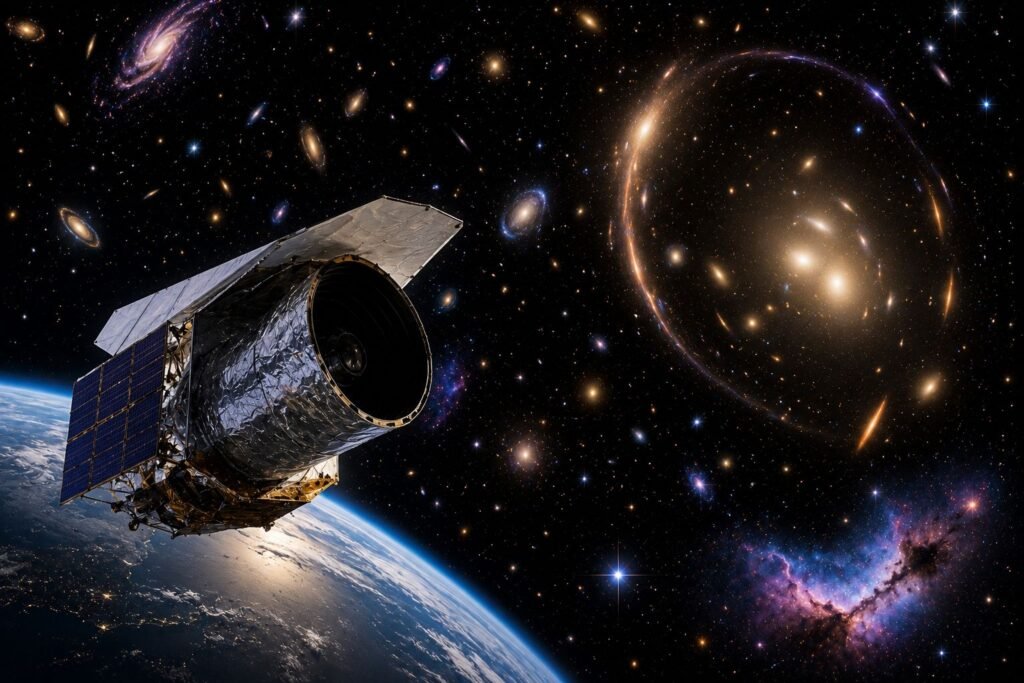
Look around you. Every person, planet, star, galaxy, black hole, and cloud of gas you’ve ever heard of makes up only about 5% of the universe. The remaining 95% is invisible. Scientists call these mysterious components dark matter and dark energy, and despite decades of research, nobody truly knows what they are.
We know they exist. We know they shape the cosmos. But we cannot see them directly. That may soon change. NASA is preparing to launch one of the most ambitious scientific instruments ever built: the Nancy Grace Roman Space Telescope. This extraordinary observatory could help humanity uncover some of the biggest secrets in the history of science.
The Next Giant Leap in Space Exploration :
The Nancy Grace Roman Space Telescope is NASA’s next flagship astrophysics mission. Named after Nancy Grace Roman, NASA’s first Chief of Astronomy and one of the key figures behind the Hubble Space Telescope, the mission is designed to answer fundamental questions about the structure and evolution of the universe.
Currently scheduled for launch no later than May 2027, Roman is expected to transform our understanding of everything from dark energy to distant alien worlds. Scientists often describe Roman as the successor to Hubble—not because it replaces Hubble, but because it expands its vision dramatically.
While Hubble showed us breathtaking details of the cosmos, Roman will allow us to study vast regions of space at once. And that changes everything.
The Breakthrough: Hubble’s Vision on a Massive Scale –
The Roman Space Telescope contains a primary mirror measuring 2.4 meters across—the same size as Hubble’s. This means Roman can capture images with a similar level of sharpness and detail. However, there is one enormous difference.
Roman’s field of view is approximately 100 times larger than Hubble’s. Imagine taking a photograph with your smartphone. Now imagine taking another photograph with the same image quality but capturing 100 times more scenery in a single shot. That is essentially what Roman will do.
What might take Hubble hundreds of images and months of observations, Roman can capture far more efficiently. This capability will allow astronomers to survey enormous portions of the universe and build the largest cosmic maps ever created.
The Universe’s Greatest Mysteries Roman’s mission focuses on three major scientific targets:
1} Dark Matter : Dark matter cannot be seen because it does not emit, absorb, or reflect light. Yet its gravity affects galaxies across the universe. Scientists estimate that dark matter makes up about 27% of the cosmos. Without it, galaxies would not behave the way they do. In many ways, dark matter acts like an invisible cosmic scaffold that helps hold the universe together.
2} Dark Energy : If dark matter is mysterious, dark energy is even stranger. Observations show that the universe is expanding. Even more surprising, that expansion is accelerating.
Something appears to be pushing galaxies apart faster and faster over time. Scientists call this unknown force dark energy. Current estimates suggest it makes up roughly 68% of the universe. Yet nobody knows what it actually is.
3} Exoplanets : Roman will also search for planets beyond our Solar System. These worlds, known as exoplanets, orbit distant stars throughout the Milky Way. Some may resemble Earth. Others could be unlike anything we have ever imagined.
The Science Behind Roman : How can a telescope detect something that is invisible?
The answer lies in one of Albert Einstein’s greatest discoveries.
Gravitational Lensing : According to Einstein’s theory of General Relativity, massive objects bend space and time around them. As light travels through this curved space, its path changes. This effect is known as gravitational lensing. Imagine placing a glass marble on a stretched rubber sheet.
The sheet bends around the marble. Now roll a smaller ball nearby. Its path curves because the surface itself has changed. The same thing happens with light in space. Roman will observe tiny distortions in the light from distant galaxies.
By measuring these distortions, scientists can map the invisible distribution of dark matter across the universe. In essence, Roman will reveal hidden structures that cannot be observed directly.
How the Telescope Works ?
Roman will operate from a special location known as the Second Lagrange Point, or L2. This region sits approximately 1.5 million kilometers from Earth. L2 provides a stable environment with minimal interference from our planet.
The telescope’s mission follows a continuous cycle:
Step 1: Survey Deep Space – Roman will observe enormous regions filled with millions of galaxies.
Step 2: Capture High-Resolution Images – Its advanced instruments will collect detailed infrared observations.
Step 3: Analyze Cosmic Distortions – Scientists will examine subtle gravitational lensing effects caused by dark matter.
Step 4: Measure Cosmic Expansion – The telescope will track how galaxies are distributed throughout space and time.
Step 5: Search for New Worlds – Roman will monitor stars for signs of orbiting planets using techniques such as gravitational microlensing. This process will generate one of the largest astronomical datasets ever created.
Why Dark Energy Could Change Everything?
Dark energy may be the most important scientific mystery of our generation. It determines the ultimate fate of the universe. If dark energy remains constant, the universe could continue expanding forever. If its behavior changes over time, entirely different scenarios become possible.
By studying billions of galaxies across cosmic history, Roman will help scientists determine how dark energy has influenced the universe for billions of years. The results could reshape modern physics.
Some researchers even believe Roman may uncover evidence that current theories are incomplete. The Search for New Earths One of Roman’s most exciting goals is the discovery of new exoplanets. Scientists estimate that the telescope could detect thousands of previously unknown worlds.
Many of these planets may be located far from their stars or may even wander through space without a parent star at all. Roman will help create an enormous catalog of potential targets for future observatories searching for signs of life. Every new planet discovered expands our understanding of what planetary systems can look like. And perhaps one day, one of those discoveries could reveal a world remarkably similar to Earth.
Impact Beyond Astronomy : The benefits of Roman extend far beyond space science. The telescope will generate enormous quantities of data. Analyzing this information requires advanced artificial intelligence and machine-learning systems.
Many of the technologies developed for astronomical data analysis often find applications in medicine, engineering, and computer science. Similar image-processing techniques already assist doctors in identifying abnormalities in medical scans. Space exploration has a long history of driving innovation on Earth, and Roman is expected to continue that tradition.
What Could Roman Discover?
The most exciting discoveries are often the ones scientists never expect Roman could reveal:
- Thousands of new exoplanets.
- Previously unseen dark matter structures.
- Rare gravitational lensing events.
- New insights into dark energy.
- Evidence that challenges current theories of physics.
- Unexpected cosmic phenomena we have never observed before.
Every major telescope in history has discovered something surprising. Roman will likely be no exception.
The Challenges Ahead –
Building a telescope capable of answering these questions is incredibly difficult. Once Roman reaches L2, astronauts will not be able to perform repair missions like those conducted for Hubble. Every component must work flawlessly.
The telescope must also withstand radiation, extreme temperatures, and years of continuous operation in deep space. In addition, scientists must manage and process enormous amounts of data arriving from across the universe. It is one of the most technically demanding scientific projects ever attempted.
Conclusion: Turning On the Lights in the Cosmic Darkness
For thousands of years, humans have looked up at the night sky and wondered what lies beyond the stars. Today, we know that most of the universe remains hidden from view. The Nancy Grace Roman Space Telescope is designed to change that.
By mapping dark matter, studying dark energy, and discovering distant worlds, Roman could provide answers to some of the deepest questions humanity has ever asked. We may soon learn what makes up the invisible majority of the universe.
And when we do, our understanding of reality itself may never be the same again.
Sources :
NASA Roman Space Telescope
https://roman.gsfc.nasa.gov
Space Telescope Science Institute
https://www.stsci.edu
European Space Agency (ESA)
https://www.esa.int
Nature Astronomy
https://www.nature.com/natureastronomy
NASA Astrophysics Division
https://science.nasa.gov/astrophysics