

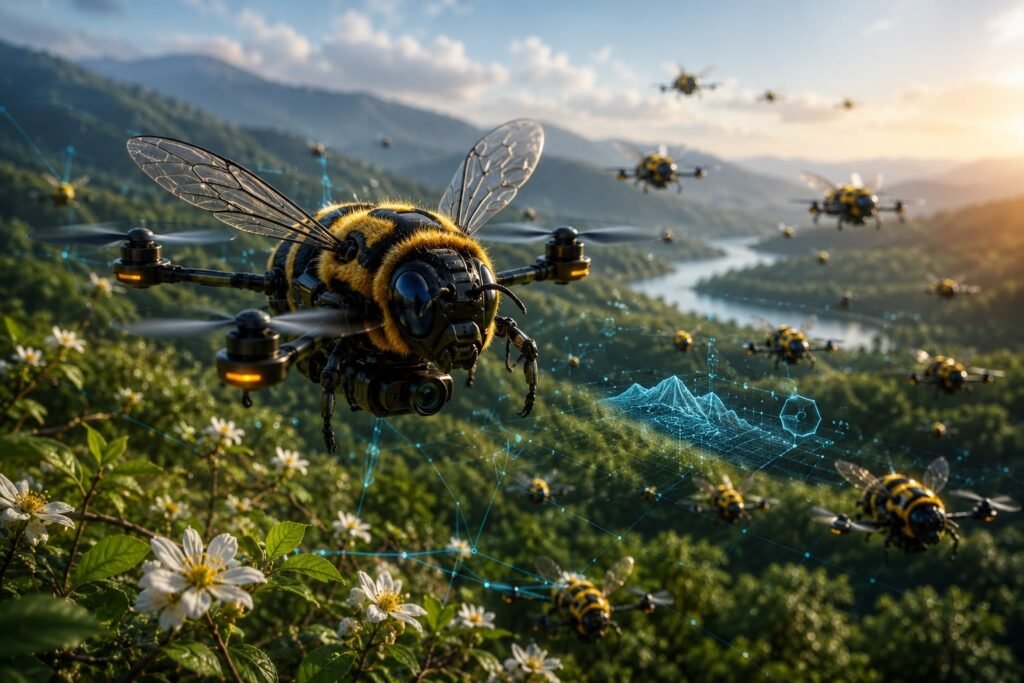
Imagine a tiny bee leaving its hive, flying across fields, forests, and flowers, collecting nectar, and then returning home with astonishing precision. Now imagine a flying robot doing exactly the same thing. No GPS, No satellite guidance, No giant computer, Just a brain smaller than a grain of rice.
For decades, scientists have been amazed by the navigation abilities of honeybees. Despite possessing one of the smallest brains in the animal kingdom, bees can travel kilometers away from their hive, avoid obstacles, locate food sources, and return home with incredible accuracy.
Now researchers are using these natural navigation strategies to build a new generation of intelligent drones. The goal is simple but revolutionary: create autonomous flying robots that can navigate the world as efficiently as insects. If successful, these bio-inspired drones could transform agriculture, disaster response, environmental monitoring, search-and-rescue missions, and even future space exploration.
Introduction : Nature’s Greatest Navigation Experts
When people think about advanced intelligence, they usually imagine humans, dolphins, or primates. Few people realize that one of the most efficient navigation systems on Earth belongs to the humble honeybee. A honeybee’s brain contains fewer than one million neurons.
For comparison, the human brain contains roughly 86 billion neurons. Yet honeybees routinely perform tasks that challenge some of the world’s most advanced robots.
They can:
- Navigate through complex environments.
- Recognize landmarks.
- Estimate distances traveled.
- Communicate locations to other bees.
- Adapt to changing surroundings.
Scientists have spent decades trying to understand how such a tiny brain accomplishes these remarkable feats. Today, that research is inspiring a completely new generation of autonomous drones.
The Breakthrough : Turning Bees Into Flying Algorithms
Recent studies published by researchers in robotics, neuroscience, and artificial intelligence have revealed that bees rely on surprisingly efficient navigation strategies. Instead of building a detailed 3D map of their surroundings like humans do, bees use simpler but highly effective methods.
They focus on motion patterns, visual landmarks, sunlight orientation, and optical flow—the apparent movement of objects as they pass by. Researchers have now begun incorporating these same principles into autonomous drones. Rather than requiring powerful processors and expensive sensors, these drones can make decisions using lightweight computational systems inspired by insect brains.
This dramatically reduces power consumption while improving navigation efficiency. For robotics engineers, this represents a major breakthrough. Instead of forcing robots to think like humans, scientists are teaching them to think like nature.
The Science Behind It : How Bees Navigate the World
One of the most fascinating discoveries involves a concept known as optical flow. As a bee flies forward, nearby objects appear to move rapidly across its field of vision, while distant objects appear to move more slowly.
By measuring these visual motion patterns, bees can estimate speed, distance, and obstacle locations without performing complex calculations. Imagine driving a car. Road signs close to you seem to rush past quickly. Mountains in the distance appear almost stationary. Your brain automatically interprets this information to judge movement. Bees perform a similar calculation continuously during flight.
Researchers discovered that this simple strategy allows bees to navigate complex environments using very little brain power. Scientists are now implementing the same principle inside drone navigation systems. The result is a machine that can fly intelligently while using far less energy than conventional autonomous aircraft.
How Does It Work?
The bee-inspired navigation system operates through a sequence of intelligent steps.
Step 1: Environmental Observation
The drone continuously observes its surroundings using lightweight cameras.
Step 2: Optical Flow Analysis
Artificial intelligence algorithms measure how objects move across the camera’s field of view.
Step 3: Distance Estimation
The system estimates the position of nearby obstacles and landmarks.
Step 4: Route Optimization
The drone calculates the safest and most efficient flight path.
Step 5: Adaptive Navigation
As environmental conditions change, the drone updates its route in real time. Unlike traditional systems that require extensive mapping and GPS support, bee-inspired drones can operate with minimal computational resources. This makes them ideal for challenging environments where conventional navigation methods may fail.
Why This Matters ?
Autonomous drones are becoming increasingly important across many industries. However, current systems often face limitations involving battery life, computing power, and environmental complexity.
Bee-inspired navigation could solve many of these problems :
1} Agriculture
Drones could monitor crops, detect disease outbreaks, and optimize irrigation systems more efficiently.
2} Disaster Response
After earthquakes, floods, or building collapses, drones could search dangerous environments where human rescuers cannot safely operate.
3} Environmental Monitoring
Scientists could deploy large fleets of autonomous drones to track wildlife populations, monitor forests, and measure pollution levels.
4} Infrastructure Inspection
Power lines, bridges, pipelines, and industrial facilities could be inspected more quickly and safely.
5} Military and Security Operations
Autonomous systems could perform reconnaissance missions in high-risk areas while reducing risks to human personnel.
The Rise of Drone Swarms :-
Perhaps the most exciting application involves drone swarms. Honeybees rarely work alone. Entire colonies coordinate their behavior through collective intelligence. Researchers are applying similar concepts to robotic systems.
Future drone swarms may consist of hundreds or even thousands of autonomous flying robots working together. Each individual drone would follow simple rules, but collectively they could accomplish incredibly complex tasks.
For example:
- Mapping entire forests.
- Monitoring wildfires.
- Searching disaster zones.
- Exploring dangerous environments.
- Conducting large-scale scientific surveys.
Much like a bee colony, the swarm would function as a single intelligent system.
Future Possibilities ?
The long-term implications are extraordinary. Scientists believe insect-inspired robotics could play a major role in future planetary exploration. Mars, the Moon, and other planetary bodies contain environments where GPS systems do not exist. Bee-inspired navigation could allow autonomous drones to explore alien landscapes independently.
Researchers are also investigating ultra-small flying robots no larger than real insects. These machines could enter confined spaces, inspect damaged buildings, monitor ecosystems, and perform tasks impossible for larger robots. One day, entire fleets of robotic insects may work alongside humans in cities, farms, factories, and even other worlds.
Challenges Ahead :-
Despite impressive progress, several challenges remain. Battery technology continues to limit flight duration. Outdoor environments are often unpredictable. Weather conditions such as rain and strong winds remain difficult for small drones to handle. Researchers must also address cybersecurity concerns, privacy issues, and regulatory frameworks governing autonomous systems.
Additionally, replicating the full intelligence of biological insects remains a significant scientific challenge. Nature has had hundreds of millions of years to perfect these systems. Engineers are only beginning to understand how they work.
Conclusion : The Future of Flight Is Already in Nature
For decades, engineers tried to build smarter robots by creating larger computers and more complex algorithms. Now scientists are discovering that some of the best solutions already exist in nature. Honeybees prove that extraordinary intelligence does not always require enormous brains.
By learning from these tiny flying insects, researchers are creating drones that are more efficient, adaptable, and autonomous than ever before. The future of robotics may not come from giant supercomputers.
It may come from understanding one of nature’s smallest navigators. And in the process, humanity could unlock a new generation of intelligent machines capable of exploring places where no robot has gone before.
Sources :
Nature
https://www.nature.com
Science
https://www.science.org
IEEE Spectrum
https://spectrum.ieee.org
Frontiers in Robotics and AI
https://www.frontiersin.org/journals/robotics-and-ai
MIT Technology Review
https://www.technologyreview.com
University of Sheffield Robotics Research
https://www.sheffield.ac.uk
Max Planck Institute for Animal Behavior
https://www.ab.mpg.de